Showing posts with label Technique. Show all posts

Tuesday, May 1, 2018

The Big Book of the Scythe


From Chapter 4, The Big Book of the Scythe - Part 1
by Peter Vido and Family


It's May Day 2018, and Peter Vido and his family have released a new book on scythes, titled "The Big Book of the Scythe, Part 1". This comprehensive instructional book is being provided at no charge, as a free download from their Scythe Connection website and related sites. It's still a work in progress, but the information is there, even if it's currently a little "rough around the edges".

The book's contents are based on the Vido family's decades of scythe usage as an integral part of their full-time homesteading and livestock farming. The Vidos have been working on this book during the past few years, and the project will be ongoing, with occasional releases of improved versions of Part 1, along with the future development of the subsequent Parts 2, 3, and 4 (with each part having a different focus, as outlined here).

A paperback version is also being produced as a fundraiser for scythe introduction to small farmers in Latin America, Asia, and Africa.

Below are links where the book can be downloaded as a PDF file:


Monday, April 23, 2018

Scythe Calisthenics -- Then and Now


(Source:  Watson's Manual of Calisthenics, 1864)


To get a wider swath, use a wider stance with more knee bending, as shown below, at right:


Source:  ScytheConnection.com               


A report from some recent scything instruction:


Once all the peening and sharpening was done, I did an experiment with the 12 of us (including me) doing a "group calisthenics" warmup starting with David Tresemer's idea of letting one's arms hang loosely while swinging/twisting hips and torso from side to side. This progressed to doing this while having the elbows bent and hands partially closed, as if holding a scythe. This swinging progressed further to include a shifting of weight from side to side, in sync with the arms. This progressed further to have increased bending of the knee closest to the hands, while the heel of the other leg comes off the ground at the end of each left or right swing. This progressed further to have each foot move forward a couple inches as it is unweighted and the heel is raised. By now, everyone is doing the scything motion, including the forward advance with each stroke. This progressed further by having everyone slow down the pace of swinging so that it matched one's breathing, exhaling during the swing to the left, and inhaling during the return swing to the right.


It was like practicing scything without holding a scythe. It seemed to prime everyone for the actual scything that immediately followed. Right off the bat, they were doing it better than I expected, including a guy who never held a scythe before who came along with a friend. So I consider the experiment a success.


Sources:


Watson's Manual of Calisthenics: A Systematic Drill-book Without Apparatus, for Schools, Families, and Gymnasiums. With Music to Accompany the Exercises
by J. Madison Watson, 1864

Scythe Connection, Mowing Technique

Personal correspondence


Wednesday, August 20, 2014

Q&A: Left-handed scythes?


Mowing with ease at seven years young.


Q:  I'm planning to get a scythe, but I'm left-handed. I know there are left-handed blades out there but, in your experience, do southpaws simply adapt to scything with a right-handed bias (as with so many other things)?

A:  [from Peter Vido] The basic 'switch' to an opposite-handed scythe can -- in some cases -- be made before the morning's worth of mowing is over (after which the refinements will continue, of course). My daughters, one naturally left-handed and the other right-handed, would agree. They both started with right-handed blades at the age of 7 or so, and only tried a left-hand version several years later, 'just for fun'. But it was no big deal for either of them to make the 'wrongly-aimed' blades cut grass just fine.

However, my daughters (as well as their uncle Alexander Vido, who is a natural left-hander) continued to use primarily right-handed scythes. The chief reason is that they were interested to try out different blade patterns, and during any one season would end up 'fooling around' with many of them. And, although left-handed blades have long been produced, the diversity of available models was always FAR less. The privilege of our left-handed scythe collection notwithstanding, they can try out MANY more right (as opposed to left) handed models, and so they stuck with the 'right-hand bias' for the most part.

I have recently experimented 'somewhat' (meaning about 10-12 hrs of actual work) with left-handed scythes because my long ago right wrist injury more or less 'ordered' the trial. As a fringe benefit, it was an interesting way to gain insights about the learning process for a beginner -- something I now feel I ought to have done long ago...

We can speculate that it would be easier for a natural left-hander to begin with (or later switch to) a right-handed scythe than for a natural right-hander to meet the same challenge, simply because in our 'right-dominant' culture the left-handers grew up adapting to many 'right hand only' tools. (An example -- ever heard of a left-handed chainsaw? Yet thousands of natural left-handers have made professional careers of using them just the same; a statement to our potential ability to adapt.)

So let's speculate why would someone specially chose to use a left-handed scythe?

Some of the possibilities:

a) They're one of the 'committed left-handers' who prefer left-handed equipment whenever it's available.

b) They are a natural left-hander who initially learned to mow with a left-handed scythe and do not want to relearn (or override) the motions.

c) They are natural right-handers but as a result of an injury to the right shoulder/arm/wrist have more available strength in their 'unnatural' side and consequently can mow better with a left-handed scythe, especially in dense and/or tall grass when the strength factor comes more into play.

d) Some people simply desire to balance their body's muscle usage in general, and while scything they can occasionally switch between right-handed and left-handed scythes.
[Yes, we do know individuals actually doing this.] 

Team mowing with left-handed scythes

One of the most frequently offered reasons against obtaining/learning how to use a left-handed scythe has been "but then you can't mow in teams". Those making this argument may be 'under the influence' of the illustration on page 61 of David Tresemer's Scythe Book. They probably also haven't used the scythe enough themselves, and consequently fail as yet to grasp the range of individual expression that -- potentially -- the use of this tool can entail. That "round and round around the field" represents a 'boxed in' approach to forage harvesting, a must to most forage-harvesting machines. Yes, it may well have been the way the large, flat and evenly-standing areas of America were mown (even with scythes) in bygone days -- but is NOT how a group of mowers traditionally progressed most of the time, in most of the scythe-using world.

Whatever the definition of 'teams' may be and how frequently groups gather (in relation to solo scythe work) these days in the 'West', I do not really know. What I do know is that whether there is a 'team' of 2 mowers or 25 who wish to cut a respective area together, there are usually several ways to accommodate either-sided folks.


Regardless of the specific numbers of people involved, some can begin moving diagonally from opposite sides of a field. Also, the traditional Swiss 'double swath' approach can effectively be implemented by equal number of left and right-handed scythes -- by the leading person (it could be either right or left-hander) starting a strip which deposits the cut matter against the still-standing grass. A person with a blade pointing in the opposite direction can then follow in the leader's heels and deposit the grass against the already accumulating (leading person's) windrow. That is not exactly how the Swiss do it, but the end effect would be the same -- a swath twice the width of one cutting movement of a blade, with all grass accumulated within a 'double windrow' in the middle. (In Switzerland, this approach is still features in at least some of their national mowing competitions. It consists of a person mowing the given length first towards the standing grass, and then turning around and making a pass away from it. It takes more than the usual judgement and skill to assure that everything under that 'double windrow has been shaven clean -- an element, besides the time taken, that is taken into consideration. That is, before the judges announce the final score, all grass is raked away to see just how cleanly the mowing was performed.)


However, the majority of folks making up the Western eco-crowd do not usually mow large fields together as 'teams'. Most end up working in irregularly-shaped terrain where adhering to certain direction is not the issue, or at least shouldn't be. In fact, all seasoned mowers who have faced a wide variety of mowing conditions would likely tell you that there were times they wished their blades were pointing in the opposite direction. That is to say, there are situations where -- due to topography and/or the predominant lay of the plants to be cut -- having a left-handed scythe in hand (or a friend with one at your side) would be advantageous. An experienced leader of a group ought to be able to quickly access the site, and then place the right and left-handers (regardless how many of each the group consists of) in positions where their respective scythe be made best use of.

Availability of left-handed blades

All the above notwithstanding, it would be unreasonable to advocate 'equal rights' in this regard, simply because the present availability of left-handed blades is severely limited.
 
The Schroeckenfux company of Austria makes one standard (#201 pattern) model - but in 70cm/28" only. They also still, from time to time, make a wider model (#108 pattern) for an old customer in Portugal, where apparently in a few select regions everybody mowed 'left-handed' once upon a time. That (Portuguese) model has been made in lengths from 18" to 28", but is not listed in the company's regular catalogue. Any wholesale customer could, I assume, ask for it although it may not be laying on the shelf in their warehouse in all the lengths at any one time. The Falci enterprise in Italy makes one of their standard models in a left hand version, but only in one (65cm/26") length. That may be the extent of the options today. In Bob Dylan's old words -- "The times they are a'changin'..."

To buck the trend would require a large scale revolution (akin to the feminist, gay or 'black power' movements). Even then, anywhere near matching the right-hand blades' models and lengths availability? Forget it. And this, from my perspective, is the only justifiable reason for advising a natural left-hander against getting stuck on their 'natural right' of bucking the present norm. In the meantime, Scythe Works still offers an inexpensive option to experiment with -- a blade model made in Austria, 20-30 years ago, made for Argentina. It is not extra light (but neither are most scythe blades today), has a relatively steep tang (making it easy to fit the simplest-to-make straight one-grip snath) and comes in 20, 22 and 26 inches, at least for now.

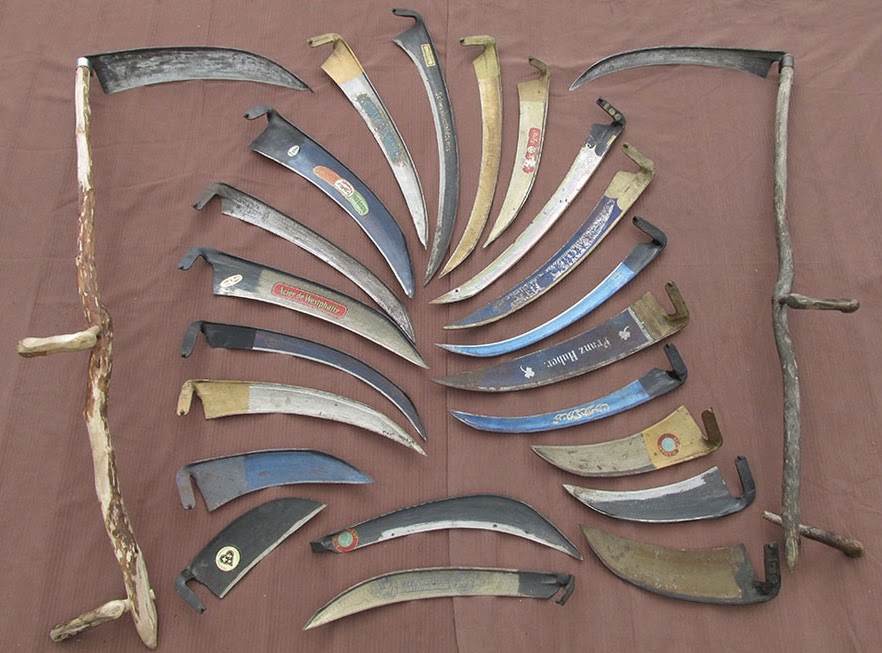
We have in our collection still other left-handed models, but it would take more digging than we can presently take time for to get them all out whatever boxes they are hiding in just to pose for a picture. Hope this suffices as a statement that, yes, left-handed scythe blades have long existed.

-- Peter Vido


Sources:
Mirror images from Mowing with ease at ScytheConnection.com
Photos from Vido family collection.




Wednesday, January 1, 2014

Scythe Users' Primer


A work-in-progress from the folks at ScytheConnection and ScytheWorks, written primarily to assist scythe users in developing countries.

UPDATE: The previously posted pages have been removed temporarily while the primer is being revised and completed.


All text and images are copyright ©2014 Peter Vido


Thursday, July 15, 2010

Q&A: Mowing in Florida


Q:  I've been mowing my lawn this year with a scythe, and so far I'm very pleased.  I've run into one problem so far.  My lawn, like many in this area, is bahia grass. This grass likes to be mown high -- four or five inches or even higher.  It resents a close cut.  Sometimes while I'm mowing, the blade will ride along the top of the grass, clipping just the tips of the blades and especially the tall V-shaped seed heads this grass sends up, and the lawn looks good afterward.  But sometimes the blade wants to "dig in" and cut the grass close to the ground, and it takes the lawn a while to recover.  I've found that it helps to keep a loose grip and not press the blade downward. I keep experimenting with hafting angles. I was wondering if you have any additional tips for achieving a high but even cut.

A:  Here are some suggestions.  (Peter Vido may add some comments if I missed something): 


(1)  Adjust your snath (if possible) so that the blade will "hover" four inches above the ground when you are holding the snath with your right arm fully extended (assuming that you are right handed).  Otherwise, trying to consistently cut four or five inches above the ground will probably tire your arm muscles and give erratic results.  


(2)  Check the horizontal balance of the blade during the swing.  If the tip of the blade naturally tends to dip downward during the stroke (which would cut some grass too short), then make adjustments to the snath (if possible) according to the instructions here concerning horizontal balance.  If snath adjustments are not possible, then move the arms and wrists slightly during the swing to keep the blade level.


(3)  It may be useful to adjust the "lay" of the blade to increase the upward tilt of the sharp edge, especially if snath adjustments are not possible and you are relying on your arm and wrist muscles to modify your swing.  This is done by inserting a wedge between the snath and the tang of the blade, as shown in the instructions here concerning the lay.


(4)  Continue experimenting with the hafting angle to see what works best for you.


(5)  Keep the blade sharp, as a dull blade either bends the grass over or requires more swinging force, which can make the cuts more difficult to control.


(6)  For best results, try to mow in the mornings (or on cloudy days, even in the rain if it's not during a thunderstorm) before the sun dries out the grass.


Good luck, and feel free to give us an update.


(Sources:  Photo "Zoey lurks in the bahia grass" by j.s. clark, 
 http://www.flickr.com/photos/57366077@N00/21798599,
 Creative Commons Attribution-NonCommercial-ShareAlike 2.0 Generic 
 http://creativecommons.org/licenses/by-nc-sa/2.0/deed.en)


Tuesday, June 8, 2010

Q&A: Undocumented scything techniques


Q:  We love our new scythes!  We did a lot of scything this past week.  After a couple of days, we started to understand the required motion (or motions - which depends a lot on the conditions).   One thing that I did not see emphasized in any documents was the importance of the tip of the blade in cutting grass.  Peter did mention the importance of taking a shallow but wide swath.  But when I tried to work out the motion for cutting in between rows of plants, where the width is shorter than the scythe blade, if I led with the tip, it worked fine, but if I led with any other part of the blade, it did not cut well. Same with cutting grass in other situations: leading with the tip is more natural, and seems to be the key to cutting grass.  Not the same with thicker-woodier stems, which must be cut with the part of the blade between the middle and the snath.  Any comments?.


A:  You are learning from one of the best teachers of scything technique; namely, experience.  (To avoid picking up bad habits that are hard to unlearn, I suggest that beginners also pay attention to instructional readings and videos, if not live instructors.)


In most cases, leading with the tip of the blade is the best technique for cutting grass, since it assures a slicing motion using the full length of the blade.  And yes, woody stems generally are best cut with the back half of the blade (nearest the snath) to minimize the torquing of the blade resulting from the increased resistance to cutting.  Exceptions do exist, as you have found, especially when trimming in confined areas.


The following techniques were described by Peter Vido in response to your question: 
For "tight" trimming, the front half of the blade can be used, with the heel off the ground a bit to fit in the limited space.  For "very tight" trimming, without much forward distance available for the blade to travel, a back-and-forth "sawing" motion can be used, where the blade is cutting in both directions.  The scythe can cut backwards with a diagonal backstroke (back and to the right, for right-handed scythes).  This backward cutting stroke is useful for cutting behind trees when the mower is standing in front of the tree, as the blade edge can be brought very close to the tree trunk.  The back and forth technique, cutting on both forward and back strokes, is also good for cutting around other obstacles.  


The moral of the story is that scythe technique is not limited to what is found in written materials, so keep experimenting!


(Source:  "Tree trunks in the grass" painting by Vincent Van Gogh, 1890, from http://commons.wikimedia.org/wiki/File:Tree_trunks_in_the_grass.jpg)


Monday, May 31, 2010

Q&A: Mowing clumps of grass on uneven ground


Q:  I would very much like to be able to "mow" my field with a scythe. But in all the videos and pictures I see of people using a scythe, the ground appears quite even. My ground is quite bumpy, and the grass (fescue, I think it is) grows in clumps.  Would a scythe work on such a field?  Would a shorter blade work better?


A:  Yes, you can use a scythe on uneven ground having clumps of grass.  (Most of my backyard could be described this way.)
However, the irregular surface will make it easier for the blade tip to dig into the ground, or for the heel of the blade to dip into a low spot, so more attention will have to be given to the horizontal control of the blade.  This usually translates to a firmer grip, less width of the swath, and occasionally some slight "hovering" of the blade above irregularities.


For such terrain, Peter Vido advises that the blade should not be longer than 70cm.  For a beginner, 60cm is probably sufficient.  If the mowing is mainly "trimming" of smaller areas, an even shorter blade can be used.


If you have a sizeable open grassy area (with uneven ground and clumps of grass) and you want to make hay, then a relatively stiff 70cm blade is recommended (like blade #9 in ScytheConnection's catalogue).  A shorter blade is easier for beginners, but will cut less grass with each stroke, requiring more time to do the job.


If you instead will be walking from clump to clump to cut them individually, then a blade as short as 40 or 45cm should be sufficient.


(Source:  Photo of "A field in Vesper, Oregon" copyright 2009 by Halvorsen brian, licensed under the Creative Commons Attribution-Share Alike 3.0 Unported license.)